
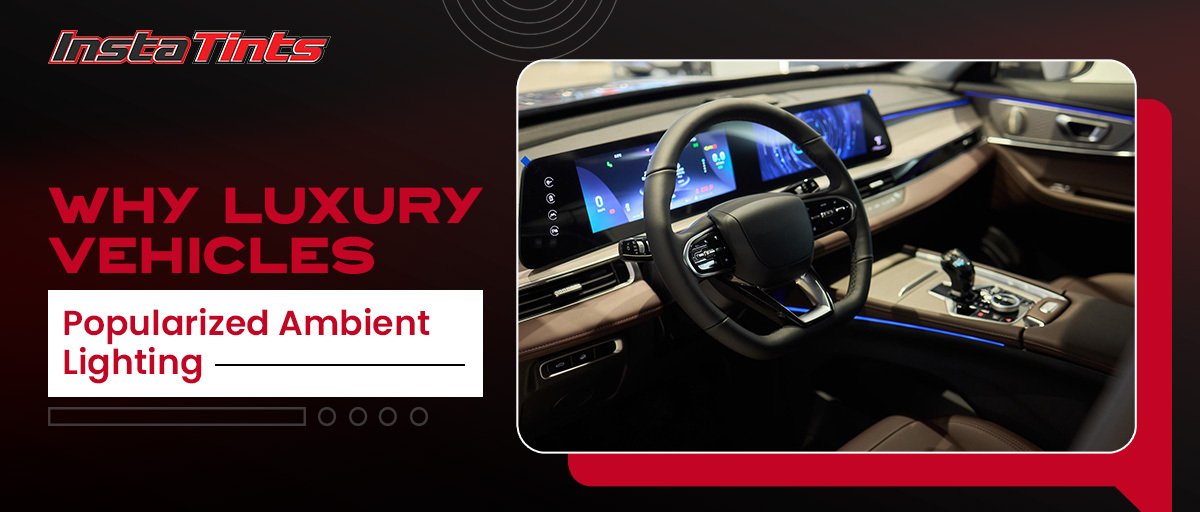
What is the article about? Ambient lighting didn’t originate here in the aftermarket industry. It began with premium automobiles, and the reason it gained traction reveals a lot about what smart interior design really adds to a driving experience.
Think back to the first time you sat in a luxury car and were actually blown away, even before the engine was turned on. The seats were nice! The materials were nice! But something more? A quality of light in the cabin that made everything seem thought out. Intentional… Somehow more costly, in ways you couldn’t quite articulate.
That was the ambient illumination working as it should. And it took the luxury sector to demonstrate to everyone else why it mattered.
It Started As A Differentiator
The problem has always been there for premium automobile manufacturers. When you reach a point of mechanical quality, how can you explain the price difference? Performance only goes so far. Eventually, safety measures become the norm. The interior is the final genuine combat, and lighting was one of its most powerful instruments.
Mercedes-Benz gets much of the credit for pushing vehicle interior lights into the mainstream luxury debate. Their multi-colour systems were not only attractive; they were customizable, mood-sensitive, and fully interwoven into the interior design. Then it was BMW’s turn. And then Audi evolved it into something of architecture. Guess what? Rolls-Royce took the Starlight Headliner out of this world!
What these businesses realized early on was straightforward: light transforms the mood of a room in a way absolutely nothing else can replicate at the same cost.
What Luxury Brands Got Right Early On
This is what they knew that mainstream didn’t:
- Light is not merely functional. There is a reason why high-end hotels and restaurants spend so much money on lighting design. It is about how a room feels, not simply how it appears.
- Warm tones induce closeness. Cool tones generate a state of awareness. Soft diffused light makes a cabin seem bigger and more sophisticated. These are not views; they are principles that premium businesses have consciously adopted.
- It addresses the difficulty of driving at night. Car ambient lighting helps lessen the stark contrast between a bright screen and a pitch-black interior. That difference is hard on the eyes on lengthy trips. Soft cabin light counterbalances it without glare.
- It gave the inside a sense of life after dark. Car door lights, vehicle interior lights, footwell illumination … they offer a sense of depth to a place that would otherwise be utterly quiet at night. A luxury automobile has to feel premium at 10 pm on the highway, just as it does at midday.
Why It Took So Long to Get to Everybody
The cost was the obstacle. Previous interior car lighting systems were substantial engineering projects with many zones, individual colour control, driving-mode and mood integration. That only made financial sense at a price where the margin was there to sustain it.
LED technology revolutionized the game. As LEDs become smaller, cheaper and more accurate in colour, the gap has narrowed quickly. What was formerly an $80,000 base price is now available at a tenth of that amount via aftermarket installation.
Where Things Stand Today
The aftermarket has gotten there. Today, the professionally installed car ambient lighting system provides the same impression in the interior that Mercedes and BMW were offering as a luxury item a decade ago. Correct location, concealed wiring, complete RGB colour spectrum; the result is a cabin that seems studied, not manipulated.
For that reason, it has become one of the most constantly requested car accessories in Canada. Drivers get a well-lit interior in a rental or a friend’s car, and they quickly desire the same thing in their own vehicle. A gloomy cabin at night really seems to be missing something, especially after you have driven with ambient illumination done well.
Concluding Thoughts
Ambient lighting was not an accident for luxury businesses. They used it to design spaces that felt premium in ways materials alone could not. The technology is accessible to anyone today. And the only variable left is getting it done correctly. And that’s an easy talk with the experts at Insta Tints Canada.
FAQs
1. What premium brand was the first to popularize ambient lighting?
The credit largely goes to Mercedes-Benz for bringing multi-zone, customizable lighting into the mainstream luxury debate. BMW and Audi soon followed with their own techniques.
2. Will aftermarket ambient lighting rival OEM luxury systems?
Depends on quality parts and competent installation. However, the impact is similar, and the price is a fraction of what a premium car demands.
3. Is it only for looks, or does it have an actual function?
Both! It helps you find the controls in the dark, reduces eye strain from the screen’s contrast at night, and improves comfort on long rides.
4. Will it operate as well in a non-luxury car?
Yeah. This effect may be seen in any vehicle. Quality materials react especially strongly, but even a basic environment looks and feels different with appropriately placed lighting.
5. How can I determine what system is best for my car?
Call the Insta Tints Canada staff. The correct solution depends on your interior architecture, how many zones you want covered, and the level of colour customization you want.