
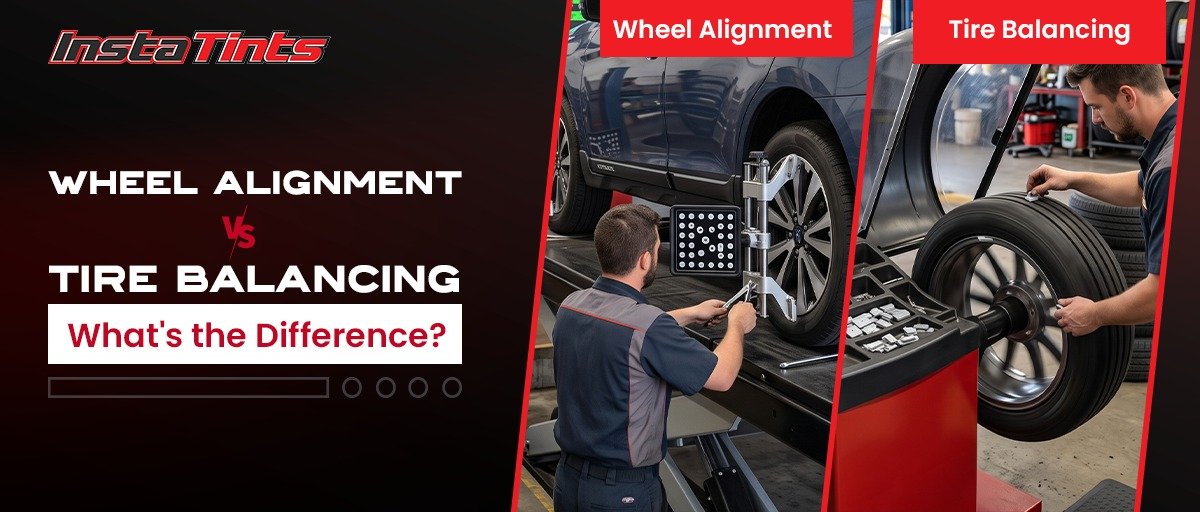
What’s the article about? Wheel alignment and tire balancing address various tire and handling issues. Learn how to recognize the signs and determine which services your vehicle may require.
Imagine a situation where you are driving your car smoothly, until you feel a vibration in your steering wheel! You pull up and get tense about how it happened. If this has ever happened to you in a few weeks, that’s your first sign to get a wheel alignment or car tire balancing, as per the needs.
Wheel alignment and tire balancing are often confused. The two services solve very different problems. If you’ve ever been confused about it, let’s get to know about them today.
What Is Wheel Alignment?
A wheel alignment adjusts your vehicle’s suspension angles as per the manufacturer’s specifications. Technicians measure angles such as camber, caster, and toe. A few common signs of wheel misalignment are as follows:
- Car pulling left or right
- Steering wheel sitting off-centre
- Uneven tread wear
- Vehicle feeling unstable when driving straight
There are so many factors that contribute to misalignment of the tire, including potholes, curbs, and rough roads. Therefore, wheel alignment service from Insta Tints Canada is definitely something worth considering after Canada’s challenging road conditions.
What Is Tire Balancing?
What car tire balancing does is correct the uneven weight distribution within the tire-and-wheel assembly. When getting a tire balancing service from Insta Tints Canada, the wheel is spun on balancing equipment. Small weights are added where needed to help it rotate smoothly.
Tire vibration at highway speeds, which can be felt through the steering wheel, seat, or floor, is one of the most common signs that your tires need balancing.
Furthermore, tires need to be balanced when installing them new, or whenever vibrations appear during driving.
A Quick Comparison: Wheel Alignment vs Tire Balancing
Here’s a difference table between the two services:
| BASIS OF DIFFERENCE | WHEEL ALIGNMENT | TIRE BALANCING |
| What does it correct? | It corrects the angles of the wheels and suspension so that they meet the manufacturer’s set specifications. | Tire balancing service corrects the uneven weight distribution between the tire and wheel so that it rotates smoothly. |
| Main Purpose | Alignment helps your vehicle track straight, handle properly, and maintain even tire contact with the road. | Balancing helps reduce vibrations and prevent unnecessary stress on tires, steering, and suspension components. |
| Warning Signs | Signs include pulling to one side, an off-centre steering wheel, or uneven wear on the inner or outer edges of the tires. | Signs usually include steering-wheel, seat, or floor vibrations, particularly when driving at higher speeds. |
| What Does the Technician Adjust? | Technicians measure and adjust suspension geometry, including toe, camber, and caster, where and whenever applicable. | Technicians use a balancing machine to identify heavy spots and add small balancing weights to correct the imbalance. |
| When Do You Need It? | An alignment check is recommended after hitting a major pothole or curb, noticing handling changes, or seeing uneven tire wear. | Balancing is commonly performed when installing new tires, after certain tire repairs, or when new vibrations develop. |
Do You Need Alignment or Balancing?
Once you take your vehicle on the road, the symptoms themselves can provide useful information. If the steering wheel is crooked or one edge of the tread is severely worn, an alignment check is recommended. Meanwhile, if you feel steering wheel vibration while driving, especially at high speeds, a tire balancing service may be necessary.
Sometimes you may require both services. A vehicle’s alignment can be correct, but its wheels are unbalanced, or it can have perfectly balanced tires with incorrect alignment angles. Therefore, the situation is totally dependent.
So, instead of deciding between a wheel alignment service and tire balancing, have the tires, wheels, steering, and suspension all evaluated together. Actually, the correct diagnosis will make sure that you only pay for the services that your vehicle requires and that your tires perform properly for an extended period of time.
FAQs
- What is the difference between wheel alignment and tire balancing?
Wheel alignment service corrects the angle and positioning of your wheels, while tire balancing service corrects uneven weight distribution in the tire-and-wheel assembly.
- How do I know if my car needs a wheel alignment?
Common signs include the car pulling to one side, an off-centre steering wheel, and uneven tire wear.
- How do I know if my tires need balancing?
Steering wheel or seat vibrations, especially at higher speeds, are common signs that your tires may need balancing.
- Do I need wheel alignment or balancing after changing tires?
Tire balancing is normally performed when tires are installed, while an alignment may be recommended if there are handling or tire-wear issues.
- Which is more important, wheel alignment or tire balancing?
Neither is universally more important; they address different problems, and your vehicle may require one or both based on its symptoms.