
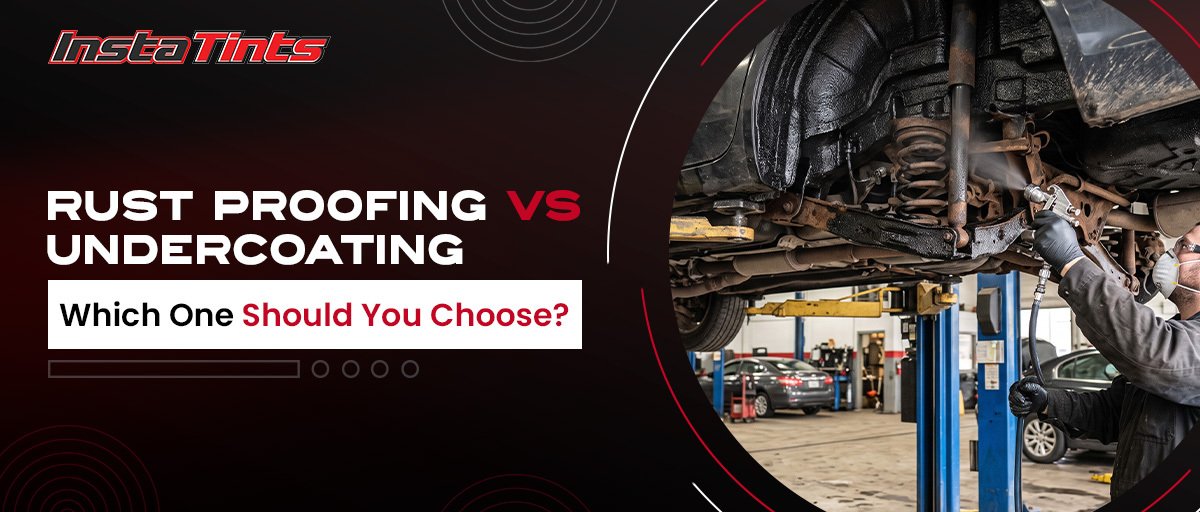
What is the article about? This explains exactly what rust proofing and undercoating truly accomplish, how they vary, and which is the best fit for your car and driving circumstances.
Ontario roads are rough on cars. October to April: Road salt. Freeze-thaw cycles that force moisture into every seam and joint. Winter spray that coats the car’s underbelly in a chemical brine that doesn’t wash off readily. The effect for any exposed car is rust. And rust in Canada doesn’t remain little.
Both problems are solved by rust proofing and undercoating. They are not the same answer. The choice is clear because you understand the difference.
What Rust Proofing Really Is?
Rust proofing targets the metal panels, seams, and cavities of the car; the areas moisture and salt get into that you can’t see and can’t get to. It is a solution for the interior of doors, rocker panels, trunk lids, and other enclosed areas where rust usually begins from the inside out.
Rust proofing materials are usually a penetrating oil- or wax-based compound that pushes out moisture and forms a barrier between the metal and the corrosive substances it is exposed to. It penetrates the cracks and crevices a surface coating can’t reach.
Rust proofing in Hamilton, rust proofing in Scarborough, rust proofing in Mississauga, or throughout Ontario is usually done on a yearly or biennial basis. The compound has to be renewed over time as it dries out or gets displaced.
What is Meant by Undercoating?
Undercoating is a surface treatment applied to the underside of the vehicle, such as the floor pan, wheel wells, frame rails, and any exposed metal parts beneath the automobile. It’s a thicker, rubberized or tarred substance that provides a physical barrier between the underside and all the road can throw at it.
Whereas rust proofing penetrates cavities, undercoating is on top of the surface. It helps protect against stone chips, road spray, and direct contact with salt on the underside panels. It also increases sound deadening; a side advantage most drivers notice soon after application.
Comparison Between Rust Proofing And Undercoating
| Rust Proofing | Undercoating | |
| Where it’s applied | Interior cavities, seams, panels | Exterior underside of the vehicle |
| Material type | Penetrating oil or wax compound | Rubberized or tar-based coating |
| What it protects against | Inside-out rust from moisture and salt | Stone chips, road spray, surface corrosion |
| How long it lasts | 1 to 2 years before reapplication | 3 to 5 years or more |
| Sound deadening benefit | No | Yes |
| Best for | New vehicles and cavity protection | Underside protection on any vehicle |
| Reapplication needed | Yes; annually or bi-annually | Less frequently |
Why Both Are Worth Considering In Ontario?
It is not an issue that is the same everywhere. Corrosion of vehicles is related to the corrosion conditions in Ontario, where road salt, along with moisture and temperature variations, produces a far more aggressive environment than other provinces with warmer winters and less salting on the roadways.
Rust proofing in Toronto, Mississauga, Scarborough and the surrounding regions is especially significant for automobiles parked outdoors, doing frequent highway driving in salt spray or held for more than three years. The automobiles that rust first in Ontario are nearly usually the ones that were never treated, not because the metal was bad, but because the environment ultimately wins if you don’t have a barrier up.
Inside Out versus Outside In
This is the most beneficial method to think about the difference. Rust almost always starts on the inside; moisture is trapped in a gap or hollow and lies against bare metal, and starts to oxidize before any surface rust shows. By the time rust shows on the exterior of a panel, the damage below is generally far further advanced.
Rust proofing in London, Ontario, and Hamilton treats that process at the origin; putting the protective chemical into the spots where rust really originates. Undercoating is a protective necessity in its own right, addressing the reality of surface exposure on the underbelly.
They are not competing alternatives. They are complementary ones that handle various aspects of the same issue.
Which One To Pick?
If the car is newer and the aim is to prevent inside-out corrosion before it begins, choose rust proofing. The best proactive way to preserve a panel over the long run is yearly or bi-annual rust proofing in Brampton, Mississauga or Scarborough.
Select undercoating if the vehicle performs a lot of highway travel, is often parked outside or has never been undercoated previously. Undercoating in Hamilton or Toronto offers a tough surface barrier able to withstand years of road spray and salt contact.
If you are planning on long-term ownership, go for both. A vehicle with a combination of rust proofing to protect the cavities and undercoating to protect the underneath surfaces is much more equipped to maintain structural integrity during five, eight, or ten Ontario winters than one with either alone.
When Should You Do the Service?
The optimal time is before your first winter of ownership, on a new or newer car, with clean, undamaged metal below. It is the second best time right now. The age of the vehicle doesn’t matter; just make sure you identify the existing rust, take care of it if required, and then coat it.
If you apply undercoat over active rust, it will trap moisture in and hasten the corrosion below. The phase that decides whether the treatment is protecting the metal or trapping the issue is a professional examination before you apply it.
Rust proofing and undercoating services are offered at all Insta Tints Canada sites – Hamilton, London, Ontario, Toronto, Brampton, Mississauga and Scarborough. Come in before winter and give your car the protection that matches what unprotected metal really faces on Ontario roadways.
FAQ
1. Can you rust proof an already rusted vehicle?
The existing rust must be addressed before applying the rust proofing compound. By applying to active rust, you retain moisture and exacerbate the underlying issue, rather than halt it.
2. How frequently should you redo the rust proofing?
Most rust proofing solutions need to be updated every 1 to 2 years. But over time, the compound dries out, breaks down, and loses its potency without reapplication.
3. Is sound deadening provided by undercoating on a vehicle?
Yes. Besides corrosion protection, a rubberized undercoating is a welcome bonus, helping to dampen road noise and vibration that gets through the floor.
4. Is rust proofing worth it on an older vehicle?
Yes, if the existing rust is properly examined and treated beforehand. If your car has some surface oxidation already, rust proofing will inhibit additional corrosion.
5. How long until undercoating has to be reapplied?
A great undercoat should last three to five years before it breaks down to the point where it has to be redone. Vehicles in extreme circumstances may need attention earlier.