
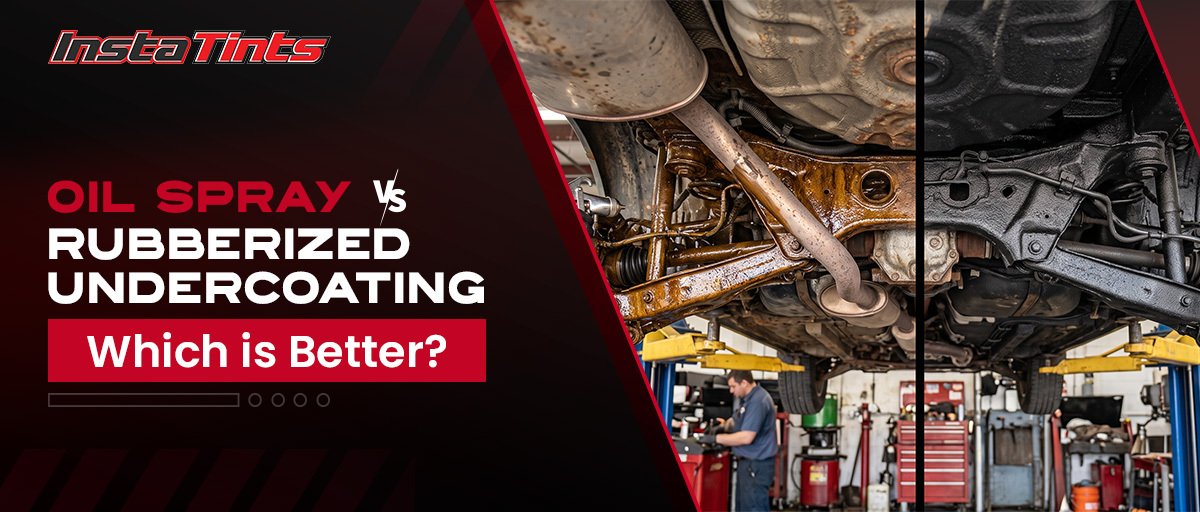
What is the article about? A fair comparison of oil spray and rubberized undercoating as rust prevention alternatives in Canada. What each one accomplishes, where it works best and how to choose which one the car truly needs.
Most drivers booking car rust proofing in Brampton, Toronto, or Scarborough for the first time don’t know which treatment to ask for. The shop offers oil spray. Someone mentioned undercoating. The prices are different. The explanations are vague. The decision gets made without fully understanding what’s going into the car.
Here’s the distinct one.
What is Oil Spray Rustproofing
Oil spray is a penetrating chemical that is sprayed to the inside cavities of the car, such as, door bottoms, rocker panels, trunk seams and any enclosed region where moisture and salt build. Low-viscosity enough to work into tight seams that a surface coating never reaches.
It displaces moisture and forms a thin flexible film over bare metal. It doesn’t crystallize, it remains rather fluid, which means it may keep spreading into other locations. The restriction is it dries up after 12-24 months. The protection is extended year by year.
What is Rubberized Undercoating
Rubberized undercoating is a thick, rubber-based coating that is placed to the exposed underneath of the vehicle, i.e., floor pan, wheel wells, and frame rails. It cures to a hard finish and provides a physical barrier against road spray, stone chips and direct salt contact.
It also contributes some considerable sound dampening. It will also cut down on noise from the road in the cabin, which is a nice perk most drivers notice instantly. The trade-off is it rests on the surface rather than getting into holes. If there are fractures or inadequate covering , any moisture that seeps behind it might be retained instead of displaced .
Compare Two Car Rust Proofing Solutions
| Feature | Oil Spray | Rubberized Undercoating |
| Where applied | Interior cavities and seams | Exterior underside surfaces |
| How it works | Penetrates and displaces moisture | Creates physical surface barrier |
| Lifespan | 1 to 2 years | 3 to 5 years |
| Reapplication | Annual or bi-annual | Every 3 to 5 years |
| Sound deadening | No | Yes |
| Reaches enclosed cavities | Yes | No |
| Protects against stone chips | No | Yes |
| Risk of trapping moisture | Low | If applied over existing rust |
When to Use Each One Best
Oil spray does the job within the car, in the locations that collect moisture and where rust really begins. Door cavities, seams in rocker panels, bottoms of B-pillars. These are the spots a surface coating can’t get to, and where 99% of the inside-out rust on most Ontario automobiles occurs.
Rubberized undercoating works on the outside-facing underside, such as the areas that take direct road spray, gravel and salt at speed. Frame rails, wheel wells, floor pan. They require a barrier, not a penetrating chemical.
Why Both Make Sense
Proper car rust proofing in Scarborough, Brampton and Toronto isn’t about one or the other. Oil spray and rubberized undercoating treat distinct portions of the same issue.
Oil spray handles where rust originates – within cavities. The underneath surface is the part that takes the most impact. Rubberized undercoating manages it. They are void without one another. For any car kept through numerous Ontario winters, the answer is the combination of both.
What’s New For Older Vehicles
Both therapies are clear possibilities for new vehicles. Clean metal. No damage.
Older cars need to be assessed before applying the undercoat. The rubberized coating put over the existing rust keeps the moisture against the metal, rather than moving it. Corrosion persists beneath the surface and cannot be seen or cured. If there is any rust, you have to deal with it before you apply the undercoating.
This problem is less acute with oil spray, since the penetrating agent keeps operating despite some surface oxidation. But any existing rust still has to be addressed before any treatment can provide real protective benefits.
Timing Is Still Important
Timing makes a big impact in the choice of oil spray, rubberized undercoating or both. Before the first winter, you want to give both treatments the best possible start by carrying out rust proofing in London, Ontario, Toronto, Scarborough, and Brampton. Clean metal, no previous exposure, optimal protection from the first cold snap.
If you wait until after the first winter, the first season of salt exposure will be unprotected. The medication still helps after that, but it’s catching up to exposure that could have been avoided completely.
At Insta Tints Canada, car rust proofing is available across all Ontario locations. Come in before the season changes and get an honest assessment of what the vehicle actually needs.
FAQs
1. Oil spray or rubberized undercoating: which is better?
Neither one is better on its own. Oil spray penetrates into cavities where rust begins. Undercoating covers the outside underneath where the road is most open. Together they provide the whole picture.
2. How often should you reapply oil spray?
Every 1 to 2 years. The compound dries up and can no longer displace moisture. Ontario winters are the annual treatment that maintains the barrier.
3. Can you put rubberized undercoating on old rust?
Not very well. First, deal with existing rust. Painting over active rust will only lock in moisture and accelerate deterioration instead of stopping it.
4. Will a rubberized undercoat minimize road noise?
Yes, I can see it. The heavy rubber covering helps to absorb vibration and road noise throughout the floorpan. Most drivers feel the change right after application.
5. Is it worth undertaking rust proofing once a year in Brampton and Toronto?
Yes, for oil-based treatments. Part of the way the protection works is annual reapplication. If you skip years, the compound will dry up, and the protection will fade before the next application.