
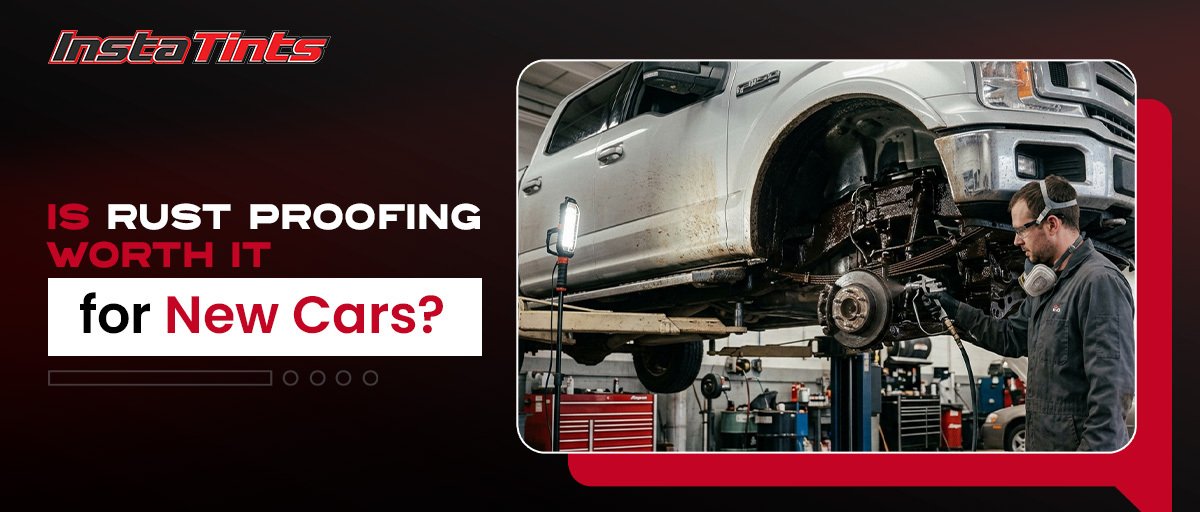
What is the article about? New vehicles come with manufacturer rust protection. The concern is whether it is sufficient for Canadian roads, or whether extra rust proofing is necessary before the first winter.
Most new automobile purchasers are questioned about rust protection when they visit the dealership. It is often offered as an add-on during the financing discussion, priced more than necessary, and simple to decline in the moment. Some customers answer yes without thinking about it. Others reject and believe the manufacturer guarantee covers everything.
Neither choice is completely informed. Here’s what you really need to know.
What Does Factory Rust Protection Actually Cover
The manufacturer includes rust protection with new automobiles. What most customers don’t realize is how limited that protection is.
Factory rust prevention normally comprises a galvanized steel coating applied during manufacture and an electrostatically applied priming layer known as an E-coat. These defend against rust perforation, which is rust that penetrates the panel from the inside out. Most manufacturers provide a guarantee against perforation for a certain number of years.
Factory protection does not cover surface rust, cosmetic rust, or corrosion that forms in seams, cavities, and joints where moisture and road salt build throughout the winter in Ontario. The guarantee covers against the worst-case scenario, but not the steady process that gets there.
Why Ontario Changes the Equation
Rust proofing in Toronto, Brampton, Mississauga, and across Ontario is not the same as in a region with warmer winters or less vigorous road salting. From late October to April, Ontario’s highways are extensively salted. That salt combines with moisture and settles in every seam, joint, and hollow on the vehicle’s underbelly, precisely where manufacturer protection is weakest.
A new automobile that goes through one Ontario winter without supplemental protection has already been subjected to corrosive conditions that the manufacturer guarantee was never intended to completely address. The protection gap is not a theoretical concept. Within three to five years, it manifests itself on exposed automobiles in visible and sometimes structural ways.
The Dealer Rust Proofing Question
Dealerships sell rust proofing as an add-on, which may cost $300 to $800 or more depending on the package. The service itself is valid. The dealership’s pricing is usually greater than what an independent shop costs for the same or better service.
Rust proofing in Hamilton, Scarborough, and London, Ontario, by a professional automotive shop often results in a more complete treatment at a lesser cost than a dealership package. The dealer’s service is handy since it occurs at the point of purchase. Because rust proofing is the primary service rather than a financing add-on, the service provided by an independent business is often more extensive.
Saying no at the dealership is not the incorrect choice. Saying no and then doing nothing till the first winter comes is.
What Additional Rust Proofing Does That the Factory Doesn’t?
The value of aftermarket rust proofing on a new car is in what it achieves that the factory treatment does not.
A penetrating oil-based rust proofing solution penetrates seams, cavities, door bottoms, rocker panels, and enclosed areas where moisture accumulates, and rust begins long before it becomes obvious on the surface. The compound displaces moisture and forms a barrier between the metal and the corrosive elements that would otherwise come into contact with bare metal during a typical Ontario winter.
Undercoating creates a physical barrier between the exposed underside: floor pan, wheel wells, and frame rails. It protects against stone chips, road spray, and direct salt contact on areas that the manufacturer’s E-coat does not completely cover after the first year of use.
Together, they target the places that are really susceptible on every new vehicle driven on Ontario roads; not the perforation situation covered by the original warranty, but the gradual, progressive corrosion that begins in year one and worsens every year thereafter.
The Timing Argument
This is where the new automobile case becomes most visible. The optimal time to rust proof a car is before the metal is exposed to corrosive environments. A new automobile treated before its first Ontario winter begins that winter with complete protection across every seam, cavity, and underneath surface.
Every winter that goes by without treatment is a winter of exposure that succeeding rust proofing must combat rather than avoid. Rust proofing in Brampton or rust proofing in Mississauga on a two-year-old vehicle still makes sense, but it’s working in conditions that a first-winter application would have avoided entirely.
What It Really Costs vs What It Prevents
A professional rust proofing coating on a new car in Ontario normally costs $150 to $400, depending on the treatment and business. A rust proofing and undercoating kit costs between $300 and $600.
Rust restoration on a non-protected car costs $500 to $1,500 per panel for surface repair and repainting. Replacement of rocker panels begins at $1,000. Structural rust restoration on frame components costs between $2,000 and $10,000 or more.
Rust proofing in Toronto or Scarborough on a new car costs less than a single panel repair. In Ontario, the preventive vs remedial cost comparison for a vehicle retained for five to 10 years is not close.
Is the factory warranty enough?
The guarantee covers perforation, which is the worst-case situation in which rust spreads throughout a panel, for the specified time period. It doesn’t matter what else Ontario’s winters do to a new car.
Surface rust, cavity corrosion, seam rust, and underbelly deterioration are all beyond the scope of the manufacturer guarantee. These are the types of rust that develop first, affect appearance and resale value, and set the stage for structural difficulties later.
The warranty is worth having. If the car will be in Ontario for more than a few years, it does not substitute for rust proofing in Scarborough or London.
FAQs
1. Is it really necessary to rust proof a new automobile with a manufacturer warranty?
Yes. Perforation, or corrosion that runs all the way through a panel, is covered under the manufacturer guarantee. It does not address surface rust, cavity corrosion, or the progressive process that occurs throughout Ontario’s winters.
2. Should I have rust proofing done at the dealership or a local shop?
Both are valid possibilities. Independent businesses often charge less and conduct more comprehensive treatments since rust proofing is their primary service rather than a financing add-on.
3. When is the optimal period to rust proof a new car?
Before the first winter. Clean metal with no past exposure is optimal for any rust proofing treatment, providing optimum protection from the outset.
4. How frequently should rust proofing be reapplied to a new car?
Oil-based treatments should be reapplied every one to two years. Undercoating typically lasts three to five years. The reapplication schedule varies depending on the kind of therapy used originally.
5. Does rust proofing harm a new vehicle warranty?
Professional rust proofing performed appropriately by a competent facility often has no effect on OEM warranty coverage. If you have specific concerns about the vehicle’s warranty terms, contact the manufacturer or dealer.