
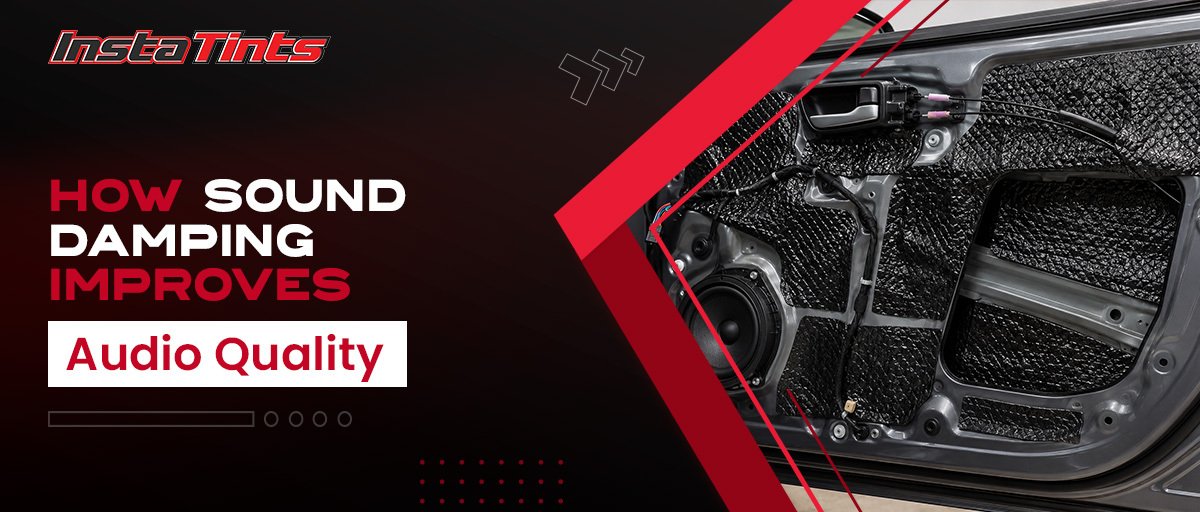
What is the article about? Better speakers only go so far in a noisy cabin. Here’s how automotive sound damping works and why it’s the number-one modification you should make.
New speakers. New head unit. Perhaps a subwoofer. When most people seek better audio, they go right to the gear. Then they reach the road, and the road noise drowns out half of everything. The bass is gone. Sound is not so clear.
The speakers were never the issue. It was always the cabin.
That’s what car sound deadening really fixes.
The Real Problem Nobody Talks About
Sheet metal shakes. Every door panel, every floor part, every thin surface in the automobile absorbs road noise and transports it right into the cabin. That noise is in the same frequency range as music. In short, these two are rivals. And in that tiff, music loses out completely!
In this case, a dense, mass-loaded material is added to the panels to enhance automotive sound damping. The shaking ends. The noise floor goes down. Suddenly, there’s an atmosphere in which they can truly work.
What Gets Treated and Why It Matters
Doors panels
The car’s greatest opportunity. Factory doors are thin, hollow and echo. The bass frequencies bounce about in them and come out muddy and feeble. This quickly changes with sound deadening on the inside of the door skin. Less rattling, more bass depth, tighter bottom end. Usually more obvious than changing the speaker itself.
Floor pan
Tyre noise is always travelling up through the floor. It is the most consistent source of cabin noise in any car. Treating the floor cuts that route down considerably, and lessens the background noise level the audio system is dealing with.
Firewall
The engine noise and heat come in here. Both are muffled by the car’s sound on the firewall. The interior grows quieter, and the audio gets clearer as damping increases.
Roof
Rain on a bare steel roof is continuous. A damped roof liner makes it a distraction that is scarcely perceptible. High-frequency road noise is also reduced.
Boot
Anyone running a subwoofer needs this. Without treatment, the boot echoes with bass output and muddies up the bottom end. Treated panels allow the subwoofer to play smoothly rather than battling the automobile’s own resonance.
Do This Before The Speakers
This is the order that most people get wrong. A quality speaker can only give you a fraction of its potential in an untreated cabin. In a well-damped cabin, the same speakers sound a lot better, with clearer midrange, tighter bass, and greater clarity at lower levels.
It’s based on automotive sound dampening. Everything else is built on it. Getting the sequence right ensures the speakers operate properly from day one, rather than being held back by panels that act against them.
What Coverage Really Makes Sense
You get the finest effect with full coverage. But even partial therapy has a huge effect.
Start with the ground and the doors. In most cars, those two locations alone account for the bulk of conflicting noise. Add the firewall, roof, and boot from there, depending on the system and how quiet you want the cabin to be.
Most folks are very astonished by the change following a simple door and floor treatment. Full coverage extends it much farther across all frequencies.
The Difference You Can Really Feel
Sound is not the only thing. A properly damped interior affects the way the automobile feels to the driver. Conversations become easier. Driving makes it easier to hear phone calls. Long rides on the highway don’t seem so taxing, since the background noise that was always there isn’t competing for your attention anymore. The main advantage is improved audio. The first thing you shall notice is that the ride is quieter and calmer.
The Final Verdict
The speakers play on the cabin’s instrument. Getting it right is how everything else in the audio chain does its thing. Drivers who do sound deadening for cars before anything else report the clearest improvement overall. Not because the hardware changed, but because the environment finally stopped working against it.
At Insta Tints Canada, car sound deadening is available as a standalone service or as part of a full audio upgrade. Come in and talk through what level of treatment makes sense for the vehicle.
FAQs
1. What is the size of the difference after automobile sound damping?
It’s a big difference! Most drivers report better bass, less road noise and a much quieter interior with only door and floor treatment.
2. How much weight does it add to the car?
It does add some weight. Not enough to make any difference to a daily driver’s performance or fuel economy.
3. Do I install sound deadening before or after speaker upgrades?
The right answer is before! Speakers are so much better from the first day they are placed in a treated cabin.
4. Can you put automotive sound deadening in older cars?
Yes. Treatment is beneficial for any sheet-metal-panel vehicle, regardless of its age or type.
5. How long does a complete installation take?
A complete treatment, including doors, floor, firewall, roof, and boot, usually takes one to two days, depending on the vehicle and the depth of coverage.