
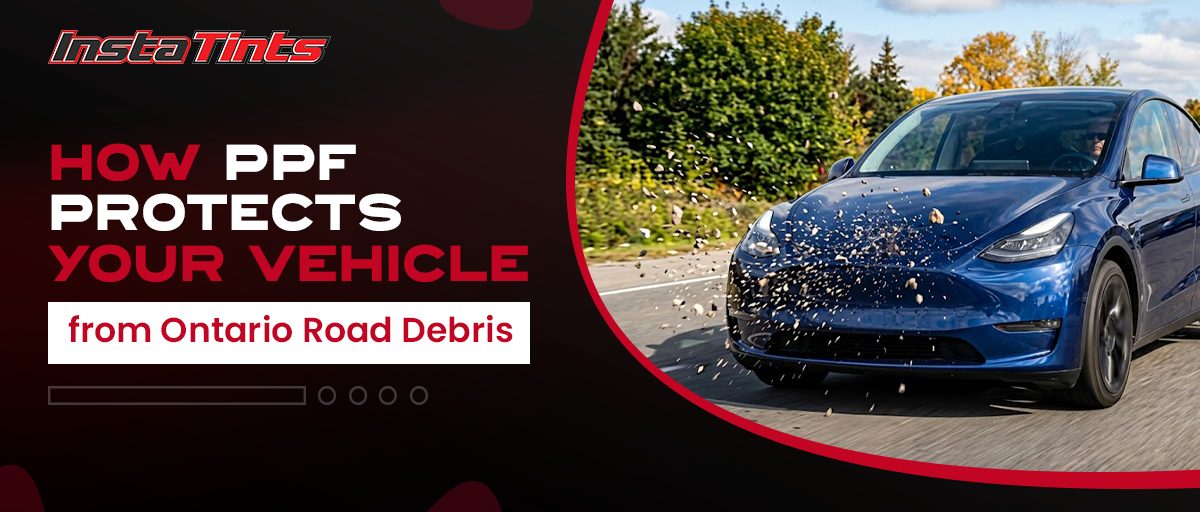
What is the article about? Over time, Ontario roads can damage your paint. Find out how Paint Protection Film (PPF) protects against rock chips, salt, brake dust, and the sun, so your finish doesn’t age before the rest of the car.
Ontario roads are rough on paint! Just ask anyone who has driven the DVP during gravel season or sat in traffic on the 401 behind a truck kicking up dirt. During the winter, salt and chemical de-icers are spread everywhere, so your clear coat is pretty much under attack all year.
When it comes to chemicals, wax works great. A good clay bar treatment works too. They won’t help much if a stone hits them while going 100 km/h, though. That is a physical issue, not a chemical one, and it needs a physical answer.
What’s Really in the Film
A real PPF wrap, sometimes called a “clear bra” but not a very accurate term, is made of polyurethane and is usually about 8 mils thick. Not rigid, but bendable. Being able to bend is really the key.
A wrapped panel doesn’t break when struck by a rock because the film bends rather than cracks. This lets the impact hit more surface area rather than go straight through to the metal. You can’t do that with bare clear coat!
What It Is Really Keeping You Safe From
If you regularly drive around in a car with PPF in Scarborough, this is about what it takes care of for you:
One clear example is rock chips, where moving stones don’t dig in but instead bounce off. What happens with road salt in the winter is not as clear. The film forms a barrier that helps prevent salt and brine from reaching damaged paint surfaces where rust can begin. This is one reason vehicles in Ontario can be more susceptible to rust over time.
Then there’s the everyday stuff that no one thinks about, like bird droppings, bug splatter, and tree sap. These contaminants can damage or stain automotive paint if left on the surface for extended periods. Even though a PPF car doesn’t suddenly get rid of these, it does protect the paint below, making it much less likely that they’ll stick to the paint and stain it before you can wipe them off.
And a good installation covers the whole panel with precisely cut film, so there is no seam or line where the security stops.
The Harm You Don’t See Right Away
Not all paint damage happens from obvious impacts. Some threats build up gradually over time. People notice rock chips right away. That’s kind of the problem: brake dust doesn’t. When you hit the brakes hard, tiny pieces of hot metal fly off the rotors and land on your paint. These particles turn into small rust spots when left alone, and these spots slowly penetrate the clear coat. It is slow and quiet, and most people don’t notice until there’s damage to see. Brake dust can still settle on the surface, but a thick PPF wrap provides an additional protective layer between contaminants and the vehicle’s paint.
Damage happens even with careful washing
Here’s something most people don’t know: even if you wash your car carefully, the paint can still develop fine scratches. Small particles of grit get stuck between the paint and the cloth, moving across the surface like fine sandpaper. If you do that enough times, the paint will get a web of fine swirl marks that make it look dull, even if the car still looks “clean.” This problem can be solved with a self-healing PPF wrap. Just put the car in the sun for a while or run warm water over it, and the top layer will soften just enough to smooth out those marks on its own.
Last Thoughts
When all is said and done, this isn’t really about making the car look good for Instagram. It means not having to pay for touch-up paint or a body shop fee every time gravel season comes around. There isn’t a good way to fix a chipped hood so that it looks like it did before.
If you’re considering Paint Protection Film for your vehicle, speaking with an experienced installer can help you determine the right level of coverage for Ontario driving conditions. If you hire a reliable provider and do it right the first time, you won’t have to worry about any of this for years. Go to Insta Tints Canada and ask for a price. Your vehicle’s finish will thank you for it when it’s gravel season again.
FAQs
How long does the self-healing thing actually take?
A few minutes in direct sun on a warm day usually does it. If it’s overcast, pouring warm water over the spot speeds things up.
Can you put PPF over a chip that’s already there?
You can, but you probably shouldn’t without fixing it first. Deep chips or spots where the paint’s already stripped tend to trap tiny air pockets under the film, which looks worse than the chip did.
Does it need special soap?
Stick to something pH-neutral. Heavy degreasers and anything highly alkaline will dry out the polyurethane faster than it should wear.
Will taking the film off later damage my paint?
Not if it’s done right. A professional uses controlled heat to lift the adhesive cleanly, leaving no residue or marks on the clear coat underneath.
Can I add a ceramic coating on top of the PPF?
Yes, just make sure it is a coating made for flexible film, not standard ceramic meant for bare paint. The wrong product can leave the surface cloudy or rough over time.