
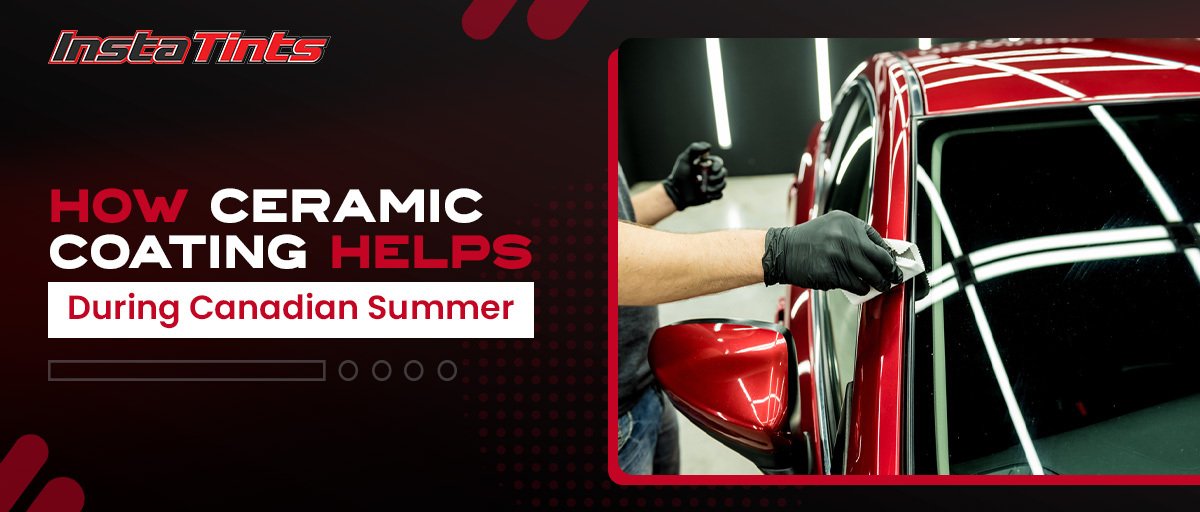
What is the article about? Canadian summers are more difficult on automobile paint than most people realize. This article explains how ceramic coating protects your car against heat, UV rays, and everything else the season throws at it.
In Canada, people remark about how harsh winter is on automobiles. Salt, ice, and freeze-thaw cycles are all real. However, summer causes its own type of deterioration, quieter and slower, that you don’t notice until the paint appears substantially worse than it did a year earlier. UV oxidation, heat buildup, tree sap, bird droppings scorching in the sun, and water stains caused by summer rain drying on a heated surface. It all adds up more quickly than most drivers think.
Summer happens regardless of ceramic coating. However, it does affect how much of that damage really reaches your paint.
Sun Is Quietly Destroying Your Paint
The sun that feels lovely on a patio is really working on your car’s clear coat. UV light degrades the chemical structure of paint over time, causing colours to fade, surfaces to oxidize, and that deep sheen to gradually vanish. It is gradual enough that most people ascribe it to aging rather than sun exposure.
UV inhibitors are used in the formulation of automotive ceramic coatings. They act as a barrier between solar radiation and the paint below, considerably reducing deterioration. A coated automobile retains its colour and shine substantially better over numerous summers than one that has not been coated. That is not a marketing promise; it is just what UV protection does when applied correctly.
Heat Buildup Is a Real Problem
An automobile parked in direct summer sun may have interior surface temperatures well above the air temperature. The heat not only makes the cabin unpleasant but also accelerates the degradation of outdoor materials. Paint expands and shrinks in response to temperature changes. Wax melt. Over the course of a season, unprotected surfaces suffer micro-damage from thermal stress.
Ceramic coating services provide a strong, semi-permanent layer over the clear coat that may withstand thermal stress better than bare paint or wax. It does not melt in high heat like a wax coating, and it retains its protective bond even throughout the weather changes characteristic of a Canadian summer – cold mornings, scorching afternoons, and unexpected thunderstorms.
Bird Droppings and Tree Sap Are Worse Than You Think
Summer means more time spent outdoors, more trees, birds, and insects. All of it falls on the automobile. Bird droppings are corrosive enough to damage bare clear coats within hours of exposure to bright sunshine. Tree sap adheres to exposed paint and hardens, making it difficult to remove without damaging the surface. Insect residue causes comparable damage to the front bumper and hood.
The ceramic coating produces a surface to which these pollutants cannot readily attach. They sit on top of the coating rather than soaking into it. A rinse or mild wipe eliminates what would normally take a lot of work and leave a mark.
Water Spots Are No Longer an Issue
Summer rain on a heated automobile is one of the quickest ways to form water spots. Water evaporates, minerals remain, and on bare paint they rapidly adhere, forming scars that are very difficult to remove without polishing. A hydrophobic surface means that water beads up and rolls off before it can sit and evaporate. Fewer water spots indicate less polishing and abrasion and longer-lasting paint.
Washing Your Car Gets Easier All Summer
Summer offers several reasons to wash the vehicle frequently, including road grime, pollen, dust, and bird droppings. Frequent cleaning of exposed paint increases the likelihood of swirl marks caused by trapped grit. Ceramic coating in Canada minimizes the amount of contaminants that adhere to the surface in the first place, allowing washing to remove more with less effort and contact with the paint. Fewer washes mean less damage and greater outcomes.
The Gloss Stays Without Any Touch-Ups
One of the most noticeable advantages of ceramic coating over wax is how long the shine lasts throughout the summer. Wax dissolves when exposed to UV light and heat; it may take six to eight weeks before the protection and shine begin to fade. That is not how ceramic coating breaks away. The gloss that was there in May is still there in September, with no reapplication, topping up, or anything other than cleaning the vehicle as usual.
Final thoughts
Summer in Canada is worth experiencing. Worrying about what the light, heat, and birds are doing to your paint should be out of the question. Ceramic coating services eliminate that problem for the season and numerous seasons beyond. If you haven’t already done so, the crew at Insta Tints Canada, with sites throughout the country, is worth speaking with before the summer ends.
FAQs
1. How long does a ceramic coating stay over the Canadian summer?
A professional-grade ceramic coating often lasts two to five years, withstanding numerous Canadian summers without requiring reapplication.
2. Is it necessary to do extra maintenance on ceramic coating during the summer?
There is no need for any specific procedure. Regular cleaning with a pH-neutral soap is all that is required to keep it in excellent condition throughout the season.
3. Can a ceramic coating be placed in the summer?
Yes, although the application is best done in a controlled atmosphere rather than in direct sunlight. These conditions are managed by a competent shop as part of the procedure.
4. Does it provide protection against summer hail damage?
Ceramic coating hardens the surface and provides some resistance to light abrasion, but it is not intended to withstand hail. PPF is a superior choice for that level of physical protection.
5. Is it worthwhile to apply automotive ceramic coating if I want to park all summer outdoors?
Much more so. Vehicles parked outdoors are subjected to higher UV exposure, bird droppings contact, and heat stress than garaged vehicles, which is precisely what ceramic coating is designed to withstand.