
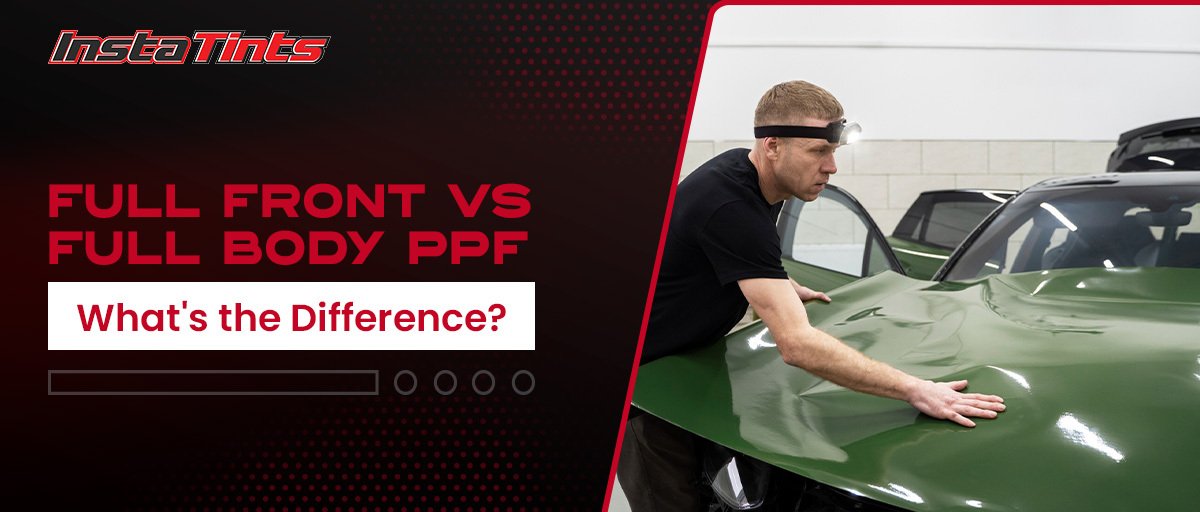
What is the article about? Two PPF options, one decision. This breaks down what each actually covers, where the money goes, and how to figure out which one makes sense for your car without overcomplicating it.
Nobody wakes up one morning and thinks, “I should look into paint protection film today.” It usually starts with a chip. Or a scratch along the rear door that appeared from nowhere. Or a friend whose three-year-old car still looks like it just left the showroom, and you can’t figure out why.
That’s when the PPF wrap conversation starts. And pretty quickly it leads to the same question – should I go with full front, or full body? They sound straightforward, but there is more to it than coverage area, so let’s actually get into it.
What does a Full Front PPF do?
Full front PPF covers the hood, front bumper, both fenders, side mirrors, and headlights. That’s it! No rear, no doors, no rocker panels. Just the face of the car!
And for a lot of people, that is all they need. The front of the car is where road damage actually happens. Stones off the highway, gravel from construction zones, insects, and salt spray in winter are some examples. The back bumper could get the odd parking scratch, but it’s not picking up pebbles at 110km/h. So if the damage you are most concerned about is the kind that happens in real driving, then the full front PPF pretty well covers the genuine exposure.
What does a Full Body PPF do?
Full body is front coverage plus everything else. The back bumper, rear quarters, rocker panels, door edges, and the little recessed areas around the door handles and door cups silently accumulate years of scratches from rings, keys, and fingernails. These aren’t the chips that make you cringe. They are the gradual, invisible sort that you only truly see when you are standing in the appropriate light, trying to figure out why the automobile looks a little worn.
Things To Think About?
Here’s an easy method to tell whether one is right for your situation:
| Your circumstance | What presumably makes sense |
| Highway commuter, high debris exposure | Full Front |
| Keeping the automobile for 5+ years | Full Body |
| Leased vehicle, must be returned in a clean condition | Full Body |
| Urban driving, largely on city streets | Full Front or Partial |
| Luxury or high-value vehicle | Full Body |
| Budget-focused, just want chip protection | Full Front |
So, in summary, the choice of PPF car wrap comes down to two things – how long you are keeping the vehicle and what kind of damage you are truly concerned about.
Is There An Installation Difference?
Time to install is also worth figuring in. Generally, a full front is a one-day job. Full body wrap takes a bit longer. You are wrapping around the door’s corners, rear curves, and tight areas around the handles, all of which require precise cutting and careful sealing.
A hasty, complete body install with raised edges at the doors looks worse than a neat, precise half wrap. Regardless of the package you choose, the procedure is the same at all locations, including the PPF Scarborough studio of Insta Tints Canada. Same film, same edge work, same quality! That regularity is what makes a wrap appear like it was factory-made, and not an afterthought.
Is Full Body PPF Worth The Cost?
It really depends! For a rented automobile, almost always yes – fines for paint damage mount up quickly.
If you are hanging onto a premium car for 10 years, the arithmetic is straightforward. Probably not for a vehicle you are selling in 2 years. The whole front conducts business; the back won’t make or break your resale talk.
There is no one perfect solution for everyone. But there is an answer that is correct for your particular automobile, and it is worth having that talk before committing either way.
FAQs
1. Do you get the full front or just the front body?
Honestly, that’s more than enough for most daily drivers. If you worry about debris damage, the front end takes the most road wear, so covering is most crucial there.
2. What does a whole body provide that a full front doesn’t?
Rear bumper, door edges, door cups, rocker panels & rear quarters. Other slower-damage areas include parking scuff marks, contact wear, and salt creep damage from behind.
3. When is the optimum time to install each option?
Full front is normally one day. Full-body films, maybe a bit more depending on the vehicle and the intricacy of the panel shapes.
4. Is it possible to view the PPF wrap on the car?
Not really if done properly! An excellent film is straightforward and clean.
5. Is it possible to start with the whole front and add panels later?
Yeah! It is a bit more complicated than doing it all at once, but it is a good way to spread out the cost and increase coverage over time.