
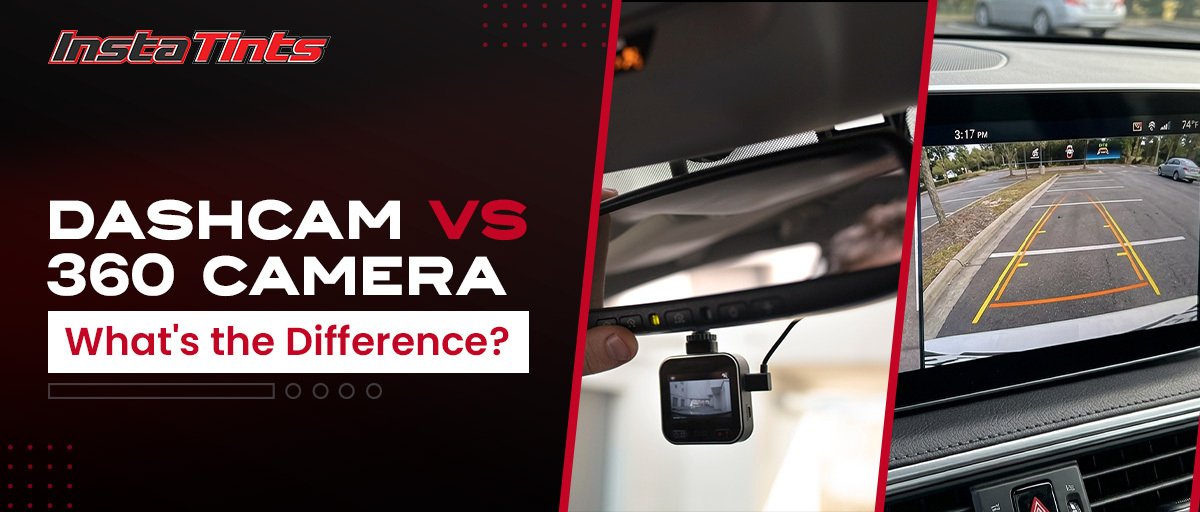
What is the article about? Both capture your vehicle’s surroundings. But they are created for distinct reasons, cover different angles, and fit different drivers. This piece will help you know which one genuinely matches your need.
The question comes up again and again. Someone who wants camera coverage on their car starts looking at dashcams, learns there are 360 systems and then isn’t sure which way makes more sense. They sound similar. But they are different products.
The truth is, here’s the breakdown.
Comparison Between Dashcam And 360 Camera System
| Dashcam | 360 Camera System | |
| Primary Purpose | Incident recording while driving | Surround visibility while driving and parking |
| Camera Count | 1 to 2 cameras | 4 cameras |
| Coverage | Front and rear | Full surround |
| View Type | Forward and rear footage | Bird’s-eye stitched view |
| Best Use | Documentation and evidence | Parking assistance and full awareness |
| Parking Mode | Yes on hardwired systems | Yes on quality systems |
| Recording Quality | High | Moderate |
| Gps Logging | Available | Rarely included |
| Incident Documentation | Primary function | Secondary function |
Where A Dashcam Wins
A dashcam is designed for one thing: to capture what occurs on the road in a way that is helpful as evidence. High-quality video, time-stamped, GPS tracked, and auto-lock on impact. The film is supposed to be legible enough to read plates, capture sequences of events and stand up in an insurance or legal dispute.
If you spend a lot of time on Ontario roads and you are a motorist installing a dash cam in Mississauga, Brampton, or Scarborough, the dash cam is the tool that mitigates the principal danger on road accidents: rear-end crashes, contested blame, hit-and-runs, and driving. This is what dash cams are made for.
It also has a parking mode that works while you are not there, recording what happens to your car in a car park, on a residential street, or any time the car is turned off but something occurs nearby.
Where The 360 Camera Shines
A 360 system stitches together four cameras, front, rear, left side and right side, into a real-time bird’s-eye picture of the car and its near surroundings. It is as much a recording device as it is a driving help.
Parallel parking. Backing a trailer. Narrow lanes. Parking near low objects that mirrors don’t pick up. A 360 system does all of this. A dashcam doesn’t seek to achieve that; it displays the driver precisely where the car is in relation to everything around it in real time.
The 360 system addresses a daily issue for big cars, truckers and anybody who is in tight locations regularly, something a dashcam can’t accomplish.
Where They Overlap And Where They Don’t
| Scenario | Dashcam | 360 Camera |
| Highway incident documentation | Yes | Limited quality |
| Parking lot collision evidence | Yes, with rear camera | Yes |
| Parking assistance in tight spaces | No | Yes |
| Hit and run while driving | Yes | Sometimes |
| Hit and run while parked | Yes, with parking mode | Yes, with parking mode |
| Reversing with a trailer | No | Yes |
| Blind spot coverage while moving | No | Yes |
| Insurance dispute footage | Yes, primary strength | Usable but secondary |
| GPS speed and location logging | Yes | Rarely available |
The Real Difference In Recording Quality
Here the two systems really begin to differ. A dashcam focuses on the quality of the film, such as high resolution, broad dynamic range, and strong low-light performance. The aim is film that can read a plate from a distance, in all lighting conditions.
A 360 system is clarity over coverage. Stitching together a flawless surround image from four cameras is computationally difficult. Individual cameras sometimes have poorer resolution than a specialized dashcam. The bird-eye perspective is perfect for good situational awareness. It’s not as good primary evidence in a contested occurrence as dedicated dashcam film.
That’s why drivers with 360 systems occasionally add a dedicated dashcam up front as well, best of both worlds in one setup.
Can You Run Both?
Yes. And it is the correct response for certain automobiles. The parking and maneuvering side is taken care of by a 360 camera. The event documentation and parking mode evidence is handled by a hardwired front dashcam. The two systems are distinct and do not overlap in a manner that would make them redundant.
Insta Tints Canada installs both systems at all sites, including dash cam installation in Hamilton, London, Ontario, Scarborough, Brampton, and Mississauga. A consultation before booking is a good way to figure out whether one system meets the demand, or if combining both makes more sense for the particular vehicle and how it is used.
Which One Should You Choose?
It is a simple approach: If your main aim is to record incidents on the road, prevent insurance fraud, and provide proof in parking lots, then go for a dashcam. This covers most everyday drivers and commuters. But if you care more about parking assistance, blind spot coverage and real-time surround vision than film quality, go for a 360 system. Great for bigger cars, frequent reversers and anybody constantly having to negotiate tight places.
If the car is high-value, it is often parked in public locations, and both on-road documentation and parking assistance are real everyday demands, choose both.
FAQ
1. Can I replace my dashcam with a 360 Camera?
Not for use as evidence. Footage from a 360 system is of poorer quality than a specialized dashcam and not designed for plate reading or insurance paperwork. Both provide comprehensive coverage for varied demands.
2. Will parking mode work on a 360 camera?
Yes, to quality systems. It turns on when it senses motion or collision and captures the space around it while the car is unattended, which is great for capturing parking lot accidents from all kinds of perspectives.
3. Do both systems need to be professionally installed?
Highly recommended for both. Precision installation and calibration of 4-camera 360 systems. Hardwiring is good for dashcams that have parking mode. Both installations are cleaner and more dependable when done by professionals.
4. What is the installation time for each system?
A dashcam usually takes between one and three hours to set up. A 360 camera system with four cameras, calibration and clean wiring takes 3 to 5 hours depending on the vehicle.
5. Where can I get both installed in Ontario?
Insta Tints Canada installs dashcams and 360 cameras in Mississauga, Brampton, Scarborough, Hamilton and London, Ontario. Come in and let’s speak about what configuration is right for the car before you make your decision.