
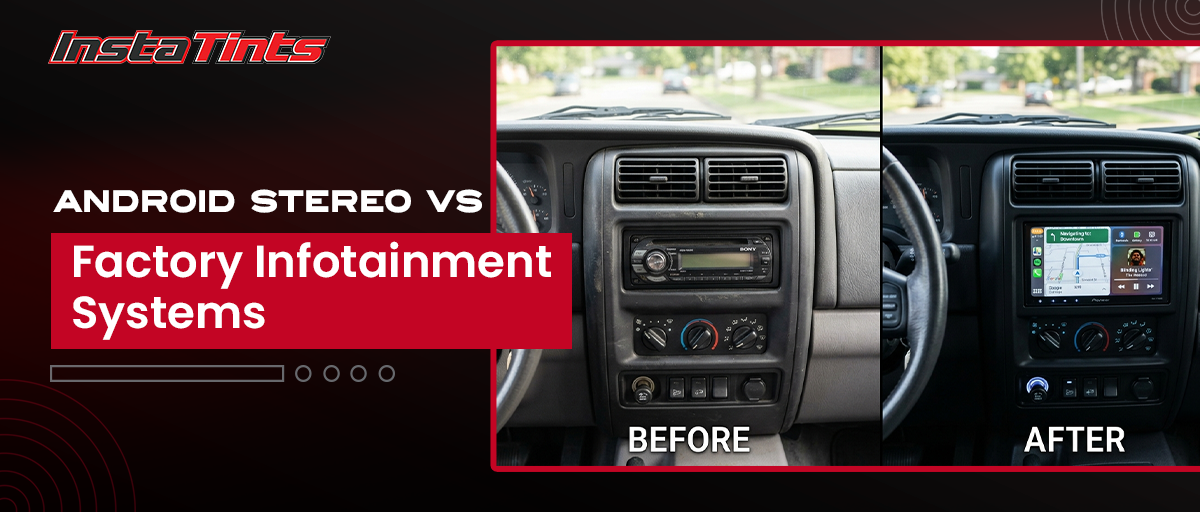
What is the article about? Factory infotainment systems seem excellent on paper. In actual life, Android stereos give more. Let’s have a straight look at how the two compare and what is genuinely worth your money.
Car manufacturers invest heavily to make their infotainment systems look great in brochures: big displays, clear UI, shiny buttons. And then you really live with one for two years, and the cracks begin to appear. Long load times, obsolete maps, applications you can’t install, software that ceased getting updates eighteen months after you drove away from the lot.
This is precisely why the discussion around Android car stereo improvements has grown so much. Drivers are not changing factory systems because they failed. In fact, they are swapping them out because they were tired of feeling restricted every time they got in the automobile.
What You Are Actually Getting Out of the Factory
The factory car infotainment system is built to the lowest common denominator. This has to work for every customer, in every market, for every conceivable use case. That means manufacturers are playing it safe: restricted app ecosystems, stiff interfaces, navigation that costs extra to upgrade, and voice assistants who understand you only 60% of the time.
Some premium brands do it better than others. But even on more expensive automobiles, the factory car infotainment system is running software that was locked in eighteen to twenty-four months before the car was created. When it gets to you, it is already behind.
What an Android Stereo Really Changes
A good Android stereo upgrade is like a tablet embedded in your dash – it runs the full Android OS and offers access to Google Maps, Waze, Spotify, YouTube Music, and almost any app you would use on your phone. The UI is very responsive with a crisp screen. Not just this, they update over the air just as your phone does.
In everyday usage, the difference is huge. Navigation based on the current road conditions. An app that genuinely knows what you want to hear. Voice instructions that really function. For those who spend actual time in their cars, they aren’t mere conveniences; they affect how the journey feels.
The Connectivity Divide
Factory systems have improved with wireless CarPlay and Android Auto integration, but they still rely on your phone to do most of the heavy lifting. The automobile is just a screen for your gadget, not an intelligent system in its own right.
A self-contained Android auto stereo does not require a phone at all. It features a SIM card for data, its own GPS, and its own app store. So you can leave your phone at home and still have full navigation, music, and calls via the vehicle. Factory systems just can’t match that kind of freedom.
Customization Is A Whole New World
Factory interface? You get what you get. You don’t get what you want. Maybe some background choices, maybe some widget rearranging. The Android car stereo upgrade experience is a whole new level. You may alter the launcher, rearrange every piece, add widgets, set up custom shortcuts, and even customize the entire interface to fit inside the automobile. They are not meant to deliver that level of customization that factory systems can’t provide.
What About The Sound Quality?
This is where manufacturing systems really differ more than people imagine. Some OEM audio settings are quite fantastic – branded systems like Bose, Harman Kardon, or Bang & Olufsen are worth retaining. The weak link in the audio chain, however, is typically the head unit itself. A high-quality built-in DAC and amplifier section in an aftermarket Android stereo will make a noticeable difference in the music output, even through the current speakers.
Is the Switch difficult to use?
Not with a professional install. A clean car stereo upgrade means the new device fits the dash correctly, keeps steering wheel controls where feasible, and doesn’t leave exposed wire or gaps around the panel. The setup at Insta Tints Canada is designed to look factory-fitted rather than bolted in a hurry. That is more important than most people understand until they see shoddy work.
To Conclude
The factory infotainment system isn’t broken. It is barely behind, and it slips farther and further behind every year while your Android stereo continues upgrading. For drivers who spend significant time in their vehicles, the update is one of those choices that’s impossible to reverse after you’ve experienced the difference. Step on in and let’s talk about what could be achievable for your particular car.
FAQs
1. Will my steering wheel controls function with an Android stereo?
Yes, usually. Professional installation involves setting the steering wheel controls to function with the new device.
2. Will it violate my auto warranty?
Canadian consumer protection standards generally say that an aftermarket stereo installation does not violate a car warranty, but check with your dealer for details.
3. Is it possible to utilize Apple CarPlay with an Android stereo?
Many Android Auto stereo devices are compatible with both Android Auto and Apple CarPlay, so you are not restricted to one platform.
4. What happens to my factory backup camera?
A skilled installation will keep your old backup camera and combine it with the new screen. You retain that function.
5. How much time does the installation require?
The majority of installations are completed in two to four hours, depending on the vehicle and the amount of integration work required.